"Rennes, the capital of the Département of Ille-et-Vilaine, has long been a regional center, rich in historical monuments and customs, and a major Brittany intellectual and industrial city. It is located at the confluence of the Ille and the Vilaine rivers, almost in the center of the département. The city is located 190 miles west-southwest of Paris.
"Rennes’ name is derived from the name of a Celtic tribe, the Redones, who founded their capital at this site in pre-Roman times. During the Roman period, Rennes served the province of Armorica as its transportation center. In 1532, Brittany became a part of France. Subsequently, in 1561, the Parliament of Brittany was established in Rennes, making it the seat of the duchy of Brittany. Ultimately, the Parliament of Brittany was one of the 13 provincial parliaments making up the kingdom of France.
"In 1720, the town was badly damaged by a fire lasting 6 days. It was rebuilt with wide avenues and canals radiating from the city’s central hub, running in parallel with the canalized Vilaine River. During the French Revolution, the Republican Army established its headquarters here for its fight against the Vendées royalists. The city was badly damaged by bombing in World War II.
"The Old Town [Vieux Rennes] is the part of Rennes that escaped the 1720 fire. The Vieux Rennes is mostly pedestrianized and is a center for bars, crêperies and boutiques. The Rue de la Monnaie, at the western edge of the Old Town, begins at the remaining 15th century city gate, the Portes Mordelaises.
 |
| Portes Mordelaises |
"Vieux Rennes is also the site for the Cathedral. Here, the two towers of the Cathédral Saint-Pierre, which was finished after 57 years of work, in the first half of the 19th century, were part of an earlier church that was partially destroyed by the 1720 fire. The cathedral is the third church to stand on this site. The stucco facing of the interior is covered with gilding and paintings. The 16th century Flemish gilded and carved wood altarpiece, in the chapel by the south transept, is a masterpiece.
 |
| Cathédral Saint-Pierre |
"Only a few buildings, on the north side of the Vilaine, survived the fire. Among the surviving structures is the Palais de Justice, which is Brittany’s Parliament. The typical Louis XV style town hall was designed and built by Jacques Gabriel during the 18th century. A number of half-timbered private mansions with carved sills, that escaped the great fire, line the streets in the vicinity of the Place du Palais and the Place de l’Hôtel de Ville. To the northeast are the French classical gardens of the Jardin du Thabor that was originally a part of the 16th century Benedictine Abbey of Sainte-Mélaine. The abbey’s lands were transformed, in the 19th century, into these gardens of varied flowers, trees, botanical garden and aviary.
 |
| Parlement de Bretagne |
"To the southeast of the Place de l’Hôtel de Ville is the building that houses both the Musée de Bretagne and the Musée des Beaux Arts. The Musée de Bretagne presents displays that provide an excellent insight into Brittany’s history. The Musée de Bretagne displays a collection of 14th through 21st century art.
"Rennes has long been the seat of an archbishopric. The Universite of Rennes was founded in 1735 and was reorganized into
Rennes I and II in 1970. The university complex includes a medical school and several other specialized schools. The university is well known for its Celtic studies.
"Rennes was traditionally an important market town. Since World War II, it has become industrially important for such products as automobiles, agricultural machinery, chemicals electronics, printing, processed food, railway equipment and textiles. Nearby, in Vern-sur-Seiche, is a petroleum refinery. The city is an important rail and road junction connecting
Paris with
Brittany."
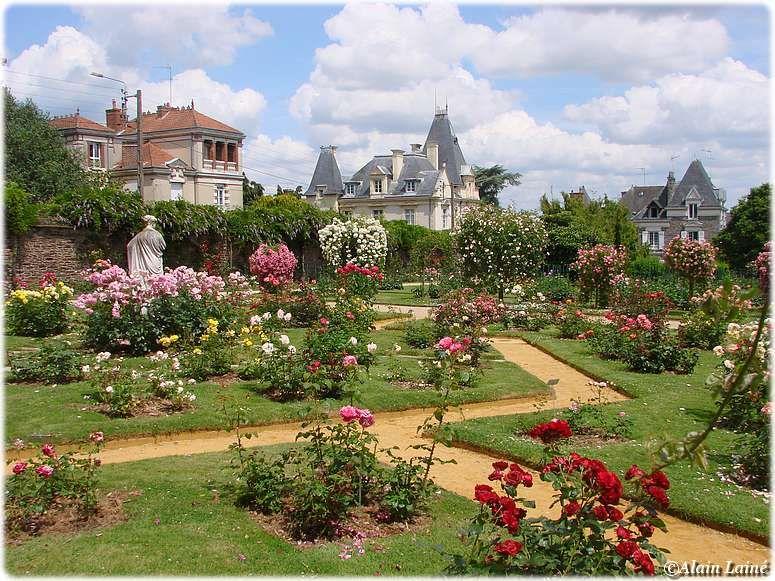 |
| Rose Garden in the Jardin du Thabor |
Source: http://www.french-at-a-touch.com/French_Regions/Brittany/brittany_town_information.htm

.jpg)


No comments:
Post a Comment