Showing posts with label Brittany. Show all posts

Saturday, October 9, 2010

Shopping and notes on the Breton language

NOTE: I think I managed to change the blog language to English, so posting comments should be easier for you anglophones ;)

Saturday has been quiet for the most part. I slept in, made a pot of potato soup for myself, and watched How I Met Your Mother in French. After lunch, I got dressed to go out and profit from the warmth and sun that decided to pay Brittany a visit for the weekend. I stopped in Eurodif, a clothes and home goods store, only to find that there was a huge sale going on! I bought towels and rugs pretty damn cheaply, but since I don’t have the keys to my apartment yet, I didn’t want to go overboard. Yet, now I’m considering heading back and getting sheets and other supplies so that I can save money later… It’ll just be annoying to move things eventually.

I talked to my parents for about an hour in the afternoon just to catch up on things. Plus, PA texted me throughout the day to comment on the student group he is assisting with; they’re getting lectures on historical things in little Norman cities from the prof with the group. His job is mostly to herd them on when they stop to take pictures.

Dinner with assistants tonight at 7 at Creperie Ste-Anne, right below my future apartment! Hopefully, I’ll get to know some more people so that I’ll have things to do on these quiet weekends.

Also, if you are considering visiting me, I work Tuesday-Friday, but I may be able to arrange long weekends if I change my hours. And here is my vacation schedule:
-Vacances de la Toussaint: Saturday 23 October to Wednesday 3 November
-Vacances de Noël (Christmas): Saturday 18 December to Sunday 2 January (though I’m already planning to spend New Year’s with friends)
-Vacances d'hiver (Winter): Saturday 26 February to Sunday 13 March
-Vacances de Printemps (Spring): Saturday 23 April to 7 June, when I leave for the States

It has been awhile since my last cultural lesson, so today I’ll introduce you to the language of Breton! Yes, Brittany has its own Gaelic-derivative language, and there are even some schools where Breton is still taught. Here is the information that I have gleaned for you:

“Breton is spoken in Lower Brittany [which means farther west on the peninsula than where I am]…It comes from a Celtic language community between Great Britain and Armorica (present-day Brittany), and even Galicia. It was the language of the upper classes until the 12th century. However, afterwards it was only the language of the people of West Brittany (Breizh Izel), while the nobility, followed by the bourgeoisie, adopted French. As a written language, the Duchy of Brittany used Latin, switching to French in the 15th century. There exists a limited tradition of Breton literature. Some Old Breton vocabulary remains in the present day as philosophical and scientific terms in Modern Breton…

“Today, despite the political centralization of France and the important influence of the media, Breton is still spoken as an everyday language by about 200,000 people. This is, however, down from 1.3 million in 1930. At the beginning of the 20th century, half of the population of Lower Brittany knew only Breton, the other half being bilingual. By 1950, there were only 100,000 monolingual Bretons, and a rapid decline since with only small handfuls of elderly monolingual speakers as of 2009. A statistical survey in 1997 found around 300,000 speakers in Breizh izel, of which about 190,000 were aged 60 or over…

“Few of those of the 15-19 year-old age group spoke Breton, which is now considered to be an endangered language…In 1977, Diwan schools were founded to teach Breton by immersion. In 2010, 13,391 students (about 1.48% of all students in Brittany) attended Diwan, Div Yezh and Dihun schools, a number rapidly growing yearly… There are also schools in secondary education (collèges and lycées) offering courses of Breton (given as either foreign language or option, instead of e.g. German, Spanish, ...), and there are about 5,000 pupils in the universities in Brittany who take this option. (http://en.wikipedia.org/wiki/Breton_language)”

Just wandering around town, you will notice that all road/street/information signs are in French and Breton, including all of the city names:

Bilingual signage in Quimper/Kemper.
Visitors to Brittany may encounter words and phrases (especially on signs and posters) such as the following:

Breton
English
degemer mat
welcome
deuet mat oc'h
you're welcome
Breizh
Brittany
brezhoneg
Breton (language)
ti, "ty"
house
ti-kêr
town hall
kreiz-kêr
town centre
da bep lec'h
all directions
skol
school
skol-veur
university
bagad
pipe band (nearly)
fest-noz
lit. "night fête", a fest deiz or "day fête" also exists
kenavo
goodbye
krampouezh
pancakes (a pancake = ur grampouezhenn)
chistr
cider
chouchenn
Breton mead
yec'hed mat
Cheers!
war vor atao
always at sea
kouign amann
rich butter and sugar cake

There is even a minor separatist movement that lives on in Brittany that wants to leave France. I’m sure that will never happen, but it was exploited by the Nazis during WWII who encouraged any subversive actions against the French government. I’ll explain this further in another post!

I've bought myself a big Brittany flag to hang in my apartment too:

Monday, October 4, 2010

Orientation day


Today was the orientation day for all of the language assistants in this départment (county) of Ille-et-Vilaine. I had to brave the pouring rain to get to a nearby high school (one metro stop and a 10 minute walk) at 9:30. Everyone was soaking wet and FREEZING! They haven’t turned on the heat yet, and it’s so chilly! In the 60s and rainy :/

Some stats from the meeting today to share:
-227 language assistants (English, Spanish, German, Italian, Russian, Chinese) in Brittany.
-5,600+ assistants in France this year.
-Brittany makes 40% of France’s milk.
-Brittany provides 55% of France’s pork.
-Brittany accounts for 45% of France’s fishing industry.
-Brittany is mostly rural with 70,000 agricultural workers but also hosts many high-tech industries.
-Brittany has a population of 3 million, which is 5% of France’s population.
-The Académie de Rennes has the best student retention rates of the country and is among the highest in baccalaureat scores (the final exam French high school students take).

The morning was spent hearing welcoming speeches from all the top officials and language inspectors of the region. A news crew actually showed up, so I’ll probably be on French tv (because I was sitting front and center) and maybe even in the Ouest France newspaper! After that excitement was done, we got info on all the forms we have to fill out to get paid, get our residence permits, get social security, get free transportation, get housing aid… There is so much paperwork in France—that stereotype is definitely true! I have to go take identity photos and copy my passport, birth certificate, and work papers for all of these things.

After shivering in the drafty amphitheater for hours, we had a free, hot lunch in the school cafeteria—with a main course of a pork and veggie skewer, it was definitely higher quality than US public school food. I ended up at a table with Germans, Spaniards, and an Austrian. The common language was French, but I heard them talk amongst themselves as well. We had to play the “Where are you from? Why are you here? Where are you teaching?” questions game, so no cultural insights there for today. And after that we moved to a classroom for coffee, cookies, and more conversation.

The afternoon orientation session was split by languages, so I was with Americans, Irish, and Brits for info on what we are actually doing as assistants. Basically, we need to encourage oral expression as much as possible, so we need to be creative! You can take an advertisement and turn it into a lesson on cultural stereotypes. You have to give them vocab and then give them an opportunity to use it, particularly in comparing their culture with yours. As assistants, we are proof that the language they study is alive and useful. We even give credibility to the scenes they have seen in American movies. It’s really quite cool :)

Tomorrow I will go to the agency to inquire as to the status of my apartment, and maybe I’ll even get the keys! Then, I have to go to work at 1:30 for one class and not again until (maybe) Friday. That gives me two days at least to set up my apartment and go bed shopping.

Bisous!

Wednesday, September 22, 2010

A brief history of Rennes


"Rennes, the capital of the Département of Ille-et-Vilaine, has long been a regional center, rich in historical monuments and customs, and a major Brittany intellectual and industrial city.  It is located at the confluence of the Ille and the Vilaine rivers, almost in the center of the département.  The city is located 190 miles west-southwest of Paris.

"Rennes’ name is derived from the name of a Celtic tribe, the Redones, who founded their capital at this site in pre-Roman times.  During the Roman period, Rennes served the province of Armorica as its transportation center.  In 1532, Brittany became a part of France.  Subsequently, in 1561, the Parliament of Brittany was established in Rennes, making it the seat of the duchy of Brittany.  Ultimately, the Parliament of Brittany was one of the 13 provincial parliaments making up the kingdom of France.

"In 1720, the town was badly damaged by a fire lasting 6 days.  It was rebuilt with wide avenues and canals radiating from the city’s central hub, running in parallel with the canalized Vilaine River.  During the French Revolution, the Republican Army established its headquarters here for its fight against the Vendées royalists.  The city was badly damaged by bombing in World War II.

"The Old Town [Vieux Rennes] is the part of Rennes that escaped the 1720 fire.  The Vieux Rennes is mostly pedestrianized and is a center for bars, crêperies and boutiques.  The Rue de la Monnaie, at the western edge of the Old Town, begins at the remaining 15th century city gate, the Portes Mordelaises. 


Portes Mordelaises

"Vieux Rennes is also the site for the Cathedral.  Here, the two towers of the Cathédral Saint-Pierre, which was finished after 57 years of work, in the first half of the 19th century, were part of an earlier church that was partially destroyed by the 1720 fire.  The cathedral is the third church to stand on this site.  The stucco facing of the interior is covered with gilding and paintings.  The 16th century Flemish gilded and carved wood altarpiece, in the chapel by the south transept, is a masterpiece.

Cathédral Saint-Pierre

"Only a few buildings, on the north side of the Vilaine, survived the fire.  Among the surviving structures is the Palais de Justice, which is Brittany’s Parliament.  The typical Louis XV style town hall was designed and built by Jacques Gabriel during the 18th century.  A number of half-timbered private mansions with carved sills, that escaped the great fire, line the streets in the vicinity of the Place du Palais and the Place de l’Hôtel de Ville.  To the northeast are the French classical gardens of the Jardin du Thabor that was originally a part of the 16th century Benedictine Abbey of Sainte-Mélaine.  The abbey’s lands were transformed, in the 19th century, into these gardens of varied flowers, trees, botanical garden and aviary.


Parlement de Bretagne

"To the southeast of the Place de l’Hôtel de Ville is the building that houses both the Musée de Bretagne and the Musée des Beaux Arts.  The Musée de Bretagne presents displays that provide an excellent insight into Brittany’s history.  The Musée de Bretagne displays a collection of 14th through 21st century art.


"Rennes has long been the seat of an archbishopric.  The Universite of Rennes was founded in 1735 and was reorganized into Rennes I and II in 1970.  The university complex includes a medical school and several other specialized schools.  The university is well known for its Celtic studies.


"Rennes was traditionally an important market town.  Since World War II, it has become industrially important for such products as automobiles, agricultural machinery, chemicals electronics, printing, processed food, railway equipment and textiles.  Nearby, in Vern-sur-Seiche, is a petroleum refinery.  The city is an important rail and road junction connecting Paris with Brittany."

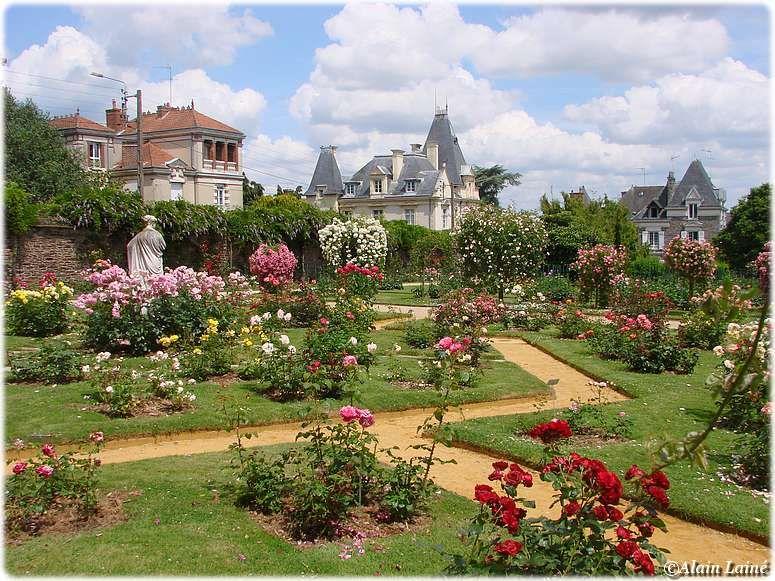
Rose Garden in the Jardin du Thabor


Source: http://www.french-at-a-touch.com/French_Regions/Brittany/brittany_town_information.htm